

In projects undertaken by SUNZO, such as ports, warehousing centers, industrial parks, scientific research parks and land reclamation projects, soft soil foundations are one of the most common engineering risk sources. Soft soils feature high natural water content, low strength and high compressibility. If buildings, roads, warehouses or storage yards are directly constructed on them, problems such as settlement, cracking or structural damage are highly likely to occur in the later stage, affecting the normal operation of the project.
Therefore, the core purpose of soft ground treatment can be summed up in one sentence: to make the underground soil more stable and reliable, capable of safely bearing the long-term operational loads of the project. Combined with the actual engineering practices of SUNZO, the “purposes” of foundation treatment are broken down into seven key points below to clearly present the core value of soft ground treatment.
Through professional soft ground treatment, most soil consolidation can be completed within a few months, allowing the foundation to enter subsequent construction as soon as possible and ensuring the project is put into operation on schedule. Common consolidation methods adopted by SUNZO (verified in practical projects):
1. Improve Bearing Capacity – Enable the Foundation to Support Actual Loads
The natural bearing capacity of most soft soils is only 20–60 kPa, while ordinary warehouses, factories and roads require 80–200 kPa, and heavy-duty storage yards and heavy equipment foundations need over 200–300 kPa. The primary purpose of soft ground treatment is to solve the problem of insufficient foundation bearing capacity:
- Increase the foundation bearing capacity to meet engineering design requirements and satisfy load demands of different scenarios;
- Prevent subsidence, deformation or damage to building structures, floors and roads;
- Ensure the long-term stability of floors, roads and equipment foundations, guaranteeing normal project operation.
Common bearing capacity improvement methods adopted by SUNZO in practical projects (verified in multiple projects):
- PVD + Vacuum Preloading: Effectively improve the overall strength of deep soil through negative pressure, suitable for large-area soft ground treatment with a shorter construction period;
- PVD + Surcharge Preloading: Accelerate soil consolidation via external loads and enhance foundation bearing capacity;
- PVD + Vacuum-Surcharge Combined Preloading: Integrate the advantages of vacuum preloading and surcharge preloading to further increase bearing capacity;
- CFG Piles / Cement Mixing Piles: Targetedly address areas requiring higher local bearing capacity, such as equipment foundations, heavy-duty storage yards and roads;
- Dynamic Compaction: Highly effective for sandy soil, clay and loess foundations, improving overall bearing capacity.
2. Control Settlement – Enable Soft Ground to Settle “Stably” Rather Than “Irregularly or Unevenly”
Soft soil will inevitably settle under loads. Without professional treatment, a series of problems will easily arise: uneven settlement (more settlement on one side and less on the other), cracking of factory or warehouse floors, ruts on roads and tilting of storage yards affecting usage.
The second core purpose of soft ground treatment is to make settlement more controllable and uniform:
- Reduce settlement to within the allowable range of engineering design;
- Ensure uniform settlement to prevent structural damage caused by differential settlement;
- Shorten the settlement cycle, completing most consolidation within 3–8 months instead of waiting for years.
The most commonly used settlement control methods by SUNZO in port and warehousing projects:
- PVD Drainage Boards: Shorten the soil drainage path, accelerate the discharge of pore water, usually used in combination with vacuum preloading or surcharge preloading;
- Vacuum Preloading: Consolidate deep soft soil through negative pressure to effectively control long-term settlement;
- Water-Gas Separation Vacuum System: Improve efficiency, enhance vacuum pumping efficiency, maintain stable vacuum transmission and optimize settlement control effects; fully replace the original jet pumps;
- Surcharge Preloading (Water Loading Preloading) (Positive Pressure): Adapt to different scenarios and accelerate soft soil consolidation;
- Vacuum-Surcharge Combined Preloading: Integrate the advantages of vacuum preloading and surcharge preloading for better results.
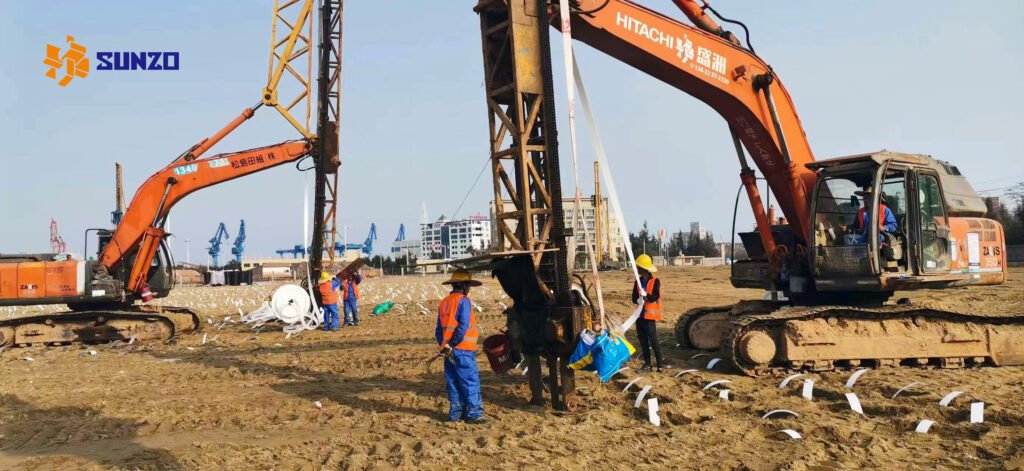
3. Improve Stability – Prevent Foundation Sliding or Weak Points During Operation
In addition to bearing capacity and settlement, the “overall stability” of soft soil foundations is also a key engineering concern, especially in scenarios such as port storage yards, warehousing and vehicle-intensive operation areas, and coastal reclaimed land, where risks of foundation sliding and lateral soil extrusion may easily occur.
The third purpose of soft ground treatment is to improve the overall foundation stability:
- Increase soil shear strength and enhance the foundation’s anti-sliding capacity;
- Eliminate weak interlayers to avoid potential local instability hazards;
- Improve foundation stiffness and reduce deformation during operation;
- Ensure the long-term stability of subsequent structural layers or floors and lower safety risks.
Common stability improvement methods adopted by SUNZO based on engineering experience:
- Cement Mixing Piles: Effectively improve soil strength and eliminate local weak areas;
- CFG Piles: Form a composite bearing layer and enhance the overall foundation stiffness;
- Dynamic Compaction: Suitable for sandy soil and backfill areas; use with caution for saturated soft clay to avoid disturbing the soil.
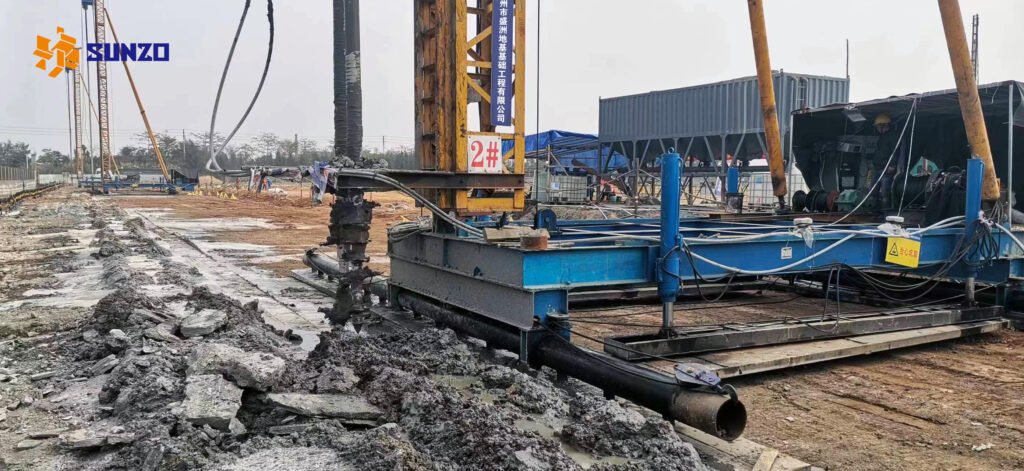
4. Accelerate Consolidation – Shorten the Multi-Year Consolidation Process to Several Months
The natural settlement cycle of many soft soils can be as long as 5–20 years, while engineering construction has clear construction period requirements and cannot wait for a long time. Therefore, accelerating soft soil consolidation and shortening the construction period is also an important purpose of soft ground treatment.
Through professional soft ground treatment, most soil consolidation can be completed within a few months, allowing the foundation to enter subsequent construction as soon as possible and ensuring the project is put into operation on schedule. Common consolidation methods adopted by SUNZO (verified in practical projects):
- PVD Drainage Boards: Shorten the drainage path and accelerate the discharge of pore water; usually used in combination with vacuum preloading or surcharge preloading;
- Vacuum Preloading: Use negative pressure to accelerate the consolidation of deep soft soil and shorten the consolidation cycle;
- Surcharge Preloading: Provide external loads (positive pressure) to promote rapid soil consolidation;
- Water Loading Preloading: Suitable for cofferdams or water-storable areas with stronger adaptability;
- Vacuum-Surcharge Combined Preloading: Integrate the advantages of vacuum preloading and surcharge preloading for better results.
5. Reduce Long-Term Maintenance Costs – Make Engineering Operation More “Worry-Free”
Poorly treated foundations will lead to a series of intractable problems during later operation: repeated floor cracking, frequent road repairs, re-leveling of storage yards, unstable factory equipment foundations, and inability of warehouse AGVs and forklifts to operate smoothly. These issues not only reduce production efficiency but also incur high maintenance costs.
Therefore, the purposes of soft ground treatment also include:
- Ensure the stability of the project for years of use and reduce operational failures;
- Significantly lower operational maintenance costs and improve project economic benefits;
- Avoid disruptions to production or logistics organization due to foundation problems and guarantee normal project operation.
This point is particularly critical in high-frequency operation scenarios such as port storage yards, warehousing centers and industrial parks.
6. Meet Special Engineering Requirements – Different Scenarios Have Different Priorities
Different engineering scenarios have different usage requirements, so the priorities of soft ground treatment also vary. Based on years of engineering experience, SUNZO tailors solutions to meet the needs of different scenarios:
- Port Storage Yards: Focus on settlement uniformity and bearing capacity to ensure cargo stacking and vehicle passage;
- Warehousing Platforms: Focus on floor stability and differential settlement control to avoid disrupting warehousing operations;
- AGV Intelligent Warehouses: Focus on flatness and no significant re-settlement in the long term to ensure smooth operation of AGV equipment;
- Scientific Research Parks and Campuses: Focus on structural deformation control to ensure building safety and user experience;
- Reclaimed Land: Focus on deep soft soil consolidation to eliminate foundation hidden dangers and lay a solid foundation for subsequent construction.
These requirements of different scenarios determine the combination of soft ground treatment technologies. SUNZO can provide customized solutions based on specific project conditions.
7. Summary: The Essential Purpose of Soft Ground Treatment
The simplest and most authentic summary is: the purpose of soft ground treatment is to build buildings or facilities on a foundation that can bear loads, settle stably and remain stable.
All soft ground treatment methods in the engineering industry – vacuum preloading, surcharge preloading, water loading preloading, vacuum-surcharge combined preloading, mixing piles, CFG piles, dynamic compaction – ultimately aim to achieve three goals:
- Sufficient bearing capacity to meet engineering load requirements;
- Stable settlement within allowable limits and uniform;
- Long-term safety to ensure stable project operation over time.
Regardless of project scale, soft soil problems must be resolved before construction rather than remedied after building completion. If you have soft ground treatment needs for your project, contact SUNZO. We will provide customized solutions tailored to your project scenario and help your project progress safely and efficiently.
 English (United States)
  Vietnamese
  Malay
Malay  French
  Spanish
  Indonesian
  Russian
  Arabic
  Thai
Thai  English (South Africa)
  Panjabi
  Portuguese
  Afrikaans
  Amharic