
Ground Improvement Project (Cement Mixing Pile Works)
Core Sample Extraction and Testing — Using Real Core Data to Guarantee Foundation Reliability
The construction quality of cement mixing piles directly determines the stability and safety of the follow-up engineering works. Recently, the core extraction and testing for the cement mixing piles of the Yangjiang Port Hailing Bay Port Area Jishu Operation Area Berths 5#–7# ground improvement project was successfully completed. The results show that the pile columns are complete, the strength meets design requirements, and the mixing is uniform. These findings provide a solid quality assurance for the project and give strong confidence for subsequent construction.
Cement Mixing Pile Core Sampling and Testing:
A “Three-Check” Approach to Strengthen Soft Ground Quality Control
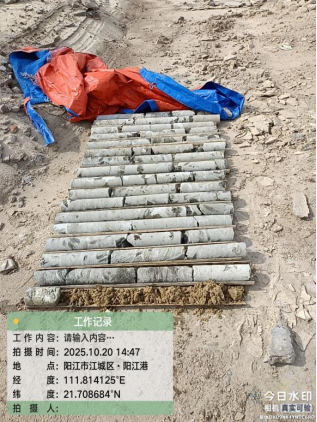
First Check: Pile Integrity — No Breaks, No Voids
Pile integrity is the foundation of all stability. Any fracture or cavity inside the pile can potentially compromise the entire structure. During the Yangjiang project testing, the focus was on the continuity and defect-free condition of the core samples. The extracted cores were complete and cylindrical, matching the designed pile depth with no voids or fractures. The surface was smooth and uniform without honeycombing or loose layers. This quality comes from precise control of drilling speed, lifting rhythm, and real-time adjustments during construction, ensuring that potential defects were prevented at the source.
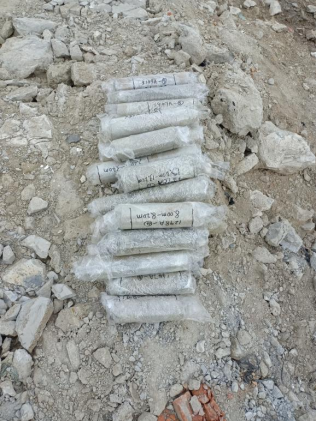
Second Check: Core Strength — Ensuring Bearing Performance Meets Standards
Pile strength is the “hard indicator” that determines whether the treated foundation can support future structural loads. The effectiveness of ground improvement relies heavily on whether the pile strength meets or exceeds design specifications. The core samples collected in this project achieved the required strength, confirming that the cement-soil reaction developed properly and that the load-bearing performance of the foundation is reliable.
Third Check: Mixing Uniformity — No Weak Zones, No Blind Spots
Uneven mixing can lead to “sandwich layers,” which significantly weaken pile performance. In this project, the core samples exhibited a consistent grey-white color, with no yellow soil patches. When lightly tapped, the sound was crisp; the fracture surfaces were firm and smooth; and even under wet conditions, the core material remained consolidated. These characteristics show that the cement slurry and the in-situ soil fully blended, leaving no “unmixed” or weak regions within the pile.
These three checks complement each other, ensuring that the cement mixing piles at the Yangjiang project passed all inspections. More importantly, they provide a strong and stable foundation for the safe execution of the upcoming structural works.
The successful test results of the Yangjiang project were not the result of luck but of solid technical execution. Before construction began, Sunzo adjusted the cement content and optimized pile parameters specifically for the soil conditions in Yangjiang. During construction, real-time monitoring and dynamic adjustments were applied to ensure consistent quality. For testing, sampling was performed strictly according to standards, and a third-party agency was engaged to verify the results. This ensured the authenticity, objectivity, and reliability of the entire assessment.
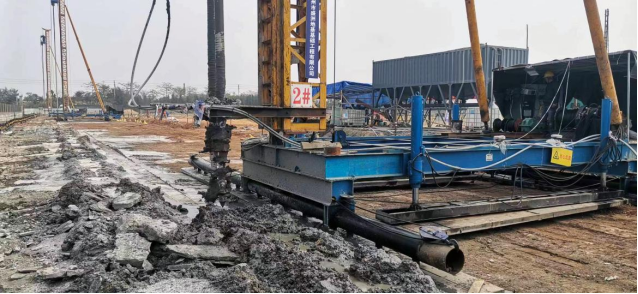
Looking ahead, Sunzo will continue to focus on infrastructure engineering, ensuring that every project receives the right technical solution, strict process control, and reliable testing validation. We remain committed to contributing to the safe and successful delivery of major foundation engineering projects.
 English (United States)
  Vietnamese
  Malay
Malay  French
  Spanish
  Indonesian
  Russian
  Arabic
  Thai
Thai  English (South Africa)
  Panjabi
  Portuguese
  Afrikaans
  Amharic