
When people talk about construction, they usually picture tall skyscrapers, long-span bridges, or large international airports. But the real factor that determines whether these structures can stand safely for decades is often hidden underground and rarely seen — the foundation. No one visits a building to admire its foundation, yet once the foundation fails, the entire structure can face catastrophic consequences.
The Leaning Tower of Pisa is a classic example: its tilt came from uneven settlement caused by poor foundation conditions. In modern engineering, the core technology used to prevent such problems is GI — Ground Improvement.
GI Defined: More Than Just “Soil Strengthening”
In engineering, GI is not a single technique. It is a systematic concept referring to any method that improves the physical or mechanical properties of soil so that it can meet the required bearing capacity and stability for structures.
GI can take many forms. It may be rigid (such as concrete piles), semi-rigid (such as stone columns or grout piles), or a combination system that integrates soft and rigid elements. In essence, GI has three main goals:
- Improve settlement behavior — making soil compression under load predictable and preventing differential settlement.
- Increase bearing capacity — enabling originally weak soft soil to support heavy structures.
- Enhance stability — improving the soil’s performance under earthquakes, flooding, or long-term loading.
Simply put, GI turns “land that is not buildable” into “land that can safely support construction.”
GI Functions: From Settlement Control to Earthquake Resistance
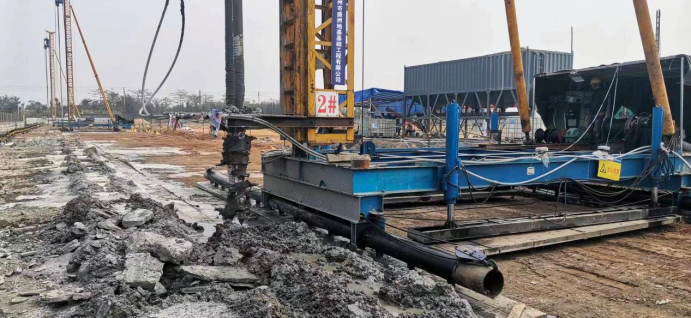
GI is used to solve several critical issues in foundation engineering:
- Settlement Control
Most building failures are not total collapses but are caused by differential settlement. In industrial buildings, even a few centimeters of uneven settlement can cause heavy equipment to shift or malfunction. GI ensures that the foundation settles uniformly or within acceptable limits. - Improved Bearing Capacity
Many projects are built over reclamation areas, coastal mudflats, or loose fill. Without treatment, the soil cannot support warehouses, factories, or high-rise loads. GI can significantly increase bearing capacity and often eliminates the need for costly deep foundations. - Enhanced Earthquake Resistance
Loose or saturated sandy soils may liquefy during an earthquake, causing buildings to instantly lose support. GI increases soil density, improves drainage, and reduces the risk of liquefaction. - Better Economic Performance
Compared with deep foundations or large-scale soil replacement, GI is often more economical. With proper design and method selection, it can save 30–50% of the cost and also shorten the construction period.
GI Application Scenarios: From Cities to Coastlines
GI is used in almost all types of projects requiring reliable foundations:
• Urban redevelopment — old districts often have uneven foundations that require GI through piles or grouting.
• Ports and airports — large reclaimed platforms and container yards rely on vacuum preloading or dynamic compaction.
• Factories and logistics parks — large warehouses require foundations that can handle heavy loading.
• Highways and railways — soft soil areas need GI to prevent track or pavement deformation.
• Bridges and tunnels — bridge abutments and tunnel portals must maintain long-term stability through GI.
Wherever “stable support” is needed, GI plays an essential role.
GI and Responsibility Division: A System of Collaboration
Unlike traditional deep foundation systems, GI involves more professional disciplines and complex responsibility allocation:
• Geotechnical engineers — provide soil investigation and initial recommendations.
• Structural engineers — determine loads and foundation design requirements.
• Design institutes (EOR) — hold overall design responsibility for building safety.
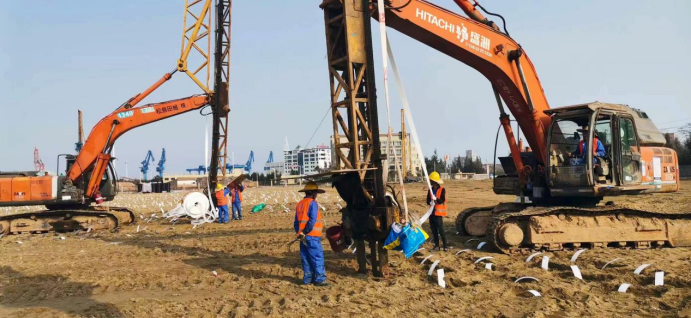
• Specialized subcontractors — companies with patented GI technologies and field experience (such as Sunzo) handle the actual GI methods.
• Supervisors and owners — ensure construction quality and verify results.
In many countries, GI design is often completed by licensed engineers from the specialized subcontractor, including signed engineering documents. In China, responsibility leans more toward the design institute and general contractor, with specialized companies providing construction and monitoring services.
Therefore, GI is not only a technical discipline; it is also a collaborative engineering system involving multiple stakeholders.
Sunzo’s Understanding of GI: A Systematic Invisible Engineering
With more than 20 years of experience, 46 patents, and over 300 project cases, Sunzo views GI as more than a single technique.
Our philosophy is:
• GI is not isolated — it must connect with structural design, schedule, and cost control.
• GI is systematic — from investigation to method selection, construction, and monitoring, all steps must form a closed loop.
• GI is long-term value — one treatment ensures decades of structural safety.
Our guiding belief is: “Foundations Built to Last a Century.”
This means we aim not only to complete construction tasks today but to ensure building safety far into the future.
Case Examples: Invisible Strength, Visible Results
• Changi Airport, Singapore — with soft soil more than 20 meters thick, Sunzo used PVD + vacuum preloading to complete consolidation in just 12 months, meeting aviation standards.
• BW Industrial Park, Vietnam — for a large area with deep miscellaneous fill, Sunzo applied dynamic compaction to complete treatment over 270,000 m² in 6 months, significantly reducing costs.
• Guangzhou Huangpu Semiconductor Plant — precision equipment required strict settlement control, so Sunzo adopted a combined pile foundation and dynamic compaction solution to ensure long-term safety.
In all these examples, the final buildings look no different from the outside. The true difference lies underground — in the GI that ensures stability.
Frequently Asked Questions (FAQ)
Q1: What is the difference between GI and traditional pile foundations?
A: Pile foundations transfer loads to deep strata and are usually more expensive. GI improves soil in place and is often more economical.
Q2: Does GI always reduce cost?
A: In most cases, yes — often by 30–50%. However, the actual savings depend on soil conditions and design requirements.
Q3: Is GI suitable for all soil types?
A: No. If the natural soil already meets engineering requirements, GI is not needed. The decision must be based on geotechnical investigation.
 English (United States)
  Vietnamese
  Malay
Malay  French
  Spanish
  Indonesian
  Russian
  Arabic
  Thai
Thai  English (South Africa)
  Panjabi
  Portuguese
  Afrikaans
  Amharic