
Introduction
In modern infrastructure construction, the foundation often determines the success or failure of an entire project. Whether a bridge remains stable, a port operates smoothly, a subway runs safely, or a skyscraper stands for a century — all depend on the reliability of the ground beneath.
However, natural conditions rarely cooperate. Soft clay, silt, reclaimed fills, and liquefiable sand layers are found almost everywhere. The question is: how can we turn “problem soils” into “buildable ground”?
The answer lies in Ground Improvement (GI).
This article provides a full-spectrum overview of GI — from principles and methods to design, risk management, and emerging trends — drawing on Shengzhou’s 20+ years of engineering experience to offer practical insights for geotechnical engineers, design institutes, and contractors.
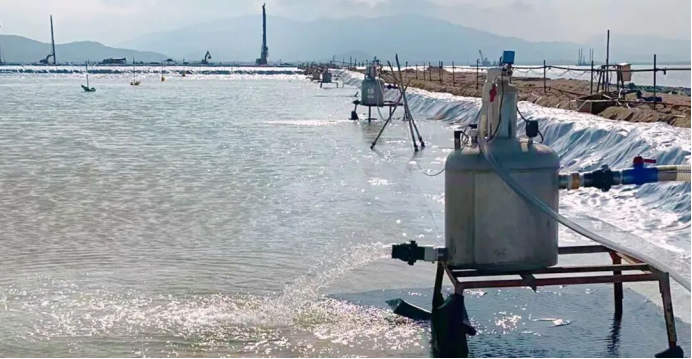
I. Principles and Objectives of Ground Improvement
1. Why Ground Improvement Is Needed
Few construction sites naturally possess ideal soil conditions. While soil replacement or deep piles can address weak ground, they are often expensive and time-consuming. GI modifies existing soil to meet engineering requirements efficiently and sustainably.
2. Core Objectives
Ground improvement serves multiple goals:
- Increase bearing capacity – ensure the foundation can support structural loads.
- Control settlement – prevent excessive or differential settlement.
- Enhance anti-liquefaction performance – maintain stability during earthquakes.
- Improve drainage and consolidation – accelerate post-construction settlement and shorten the construction period.
- Increase overall stability – protect slopes, embankments, and subgrades.
II. Main Ground Improvement Methods
1. PVD + Vacuum Preloading
Principle:
Combines artificial drainage channels with negative pressure dewatering to rapidly densify soft soil — the key solution for low-strength, slow-settling ground.
Shengzhou’s patented technologies:
- Vacuum preloading without drainage sand blanket (Patent No. 2007100312215)
- Soft ground treatment with timed drainage channel closure (201710107951.2)
- Water–vapor separation device for vacuum preloading (201510083730.7)
- Water–gas separation vacuum preloading method and apparatus (201310481313.9)
Advantages:
- Significantly improves consolidation efficiency and soil strength
- Shortens construction duration
- Saves materials and protects the environment
Applications:
Port yards, airport runways, highways, reclamation projects
Case Studies:
Singapore Changi Airport, Singapore Tekong Island, Vietnam Formosa Steel Plant, Dhamra Port (India), Macau University (Zhuhai), HKUST (Guangzhou), GLP & ESR logistics parks, Guangzhou Nansha Port, Yangjiang LNG storage terminal
2. PVD + Surcharge Preloading
Principle:
Combines vertical drainage with surface loading to accelerate soil consolidation — balancing efficiency and cost.
Advantages:
- Accelerated consolidation and shorter project duration
- Broad applicability for large areas
- Cost-effective and reliable
- Stable settlement control
Applications:
Multi-story factories, logistics yards, highways, reclaimed land developments
Case Studies:
Iraq Faw Port, Macau New Reclamation Zone A, Hong Kong–Zhuhai–Macao Bridge, Yangjiang Port
3. Replacement (Soil Exchange Method)
Principle:
Excavate the top 3 m of weak or fill soil and replace it with compacted sand, gravel, or graded stone (compaction ≥ 0.95). Forms a “replacement layer” to support surface loads.
Applications:
Residential buildings, small factories, shallow foundations (soft layer ≤ 2 m).
Advantages:
Simple, fast, and inexpensive — but limited to shallow treatment.
4. Shallow Dynamic Compaction (≤ 1000 kN·m per drop)
Principle:
A 10–20 t weight dropped from 5–8 m compacts the top 1–3 m of soil, reducing voids and improving density.
Applications:
Loose sand or fill for temporary yards or road subgrades.
Advantages/Disadvantages:
Efficient and low-cost, but noisy (> 85 dB) and unsuitable near existing structures.
5. Deep Dynamic Compaction (≥ 2000 kN·m per drop)
Principle:
A 20–40 t weight dropped from 10–20 m transmits energy to 3–10 m depth, densifying deep loose soils.
Applications:
Airport runways, industrial zones, deep reclaimed ground.
Advantages:
Effective deep strengthening at low cost, but requires heavy machinery and has vibration impact up to 50 m.
6. Cement Mixing Piles
Principle:
A chemical reaction between cement and soft soil solidifies the ground in situ, turning “soft soil” into “hard ground.”
Advantages:
- Minimal environmental disturbance
- Precise and controllable strength improvement
- Economical and time-efficient
- Suitable for varied conditions
Applications:
Basements, metro stations, retaining walls, and waterproof barriers.
III. Method Selection and Design Logic
1. Decision Process
- Conduct geotechnical investigation and groundwater assessment
- Define performance objectives
- Compare methods using a decision matrix
- Optimize combined techniques for cost and effectiveness
2. Method Selection Matrix
| Soil Conditions | Recommended Method | Typical Applications |
|---|---|---|
| Thick soft clay, silt (5–20 m) | PVD + Vacuum Preloading | Ports, highways, industrial parks requiring strict settlement control |
| Soft clay, silty clay (3–15 m) | PVD + Surcharge Preloading | Roads, embankments, industrial foundations |
| Fill or shallow weak soil (≤ 3 m) | Replacement | Small buildings, parking lots, shallow subgrades |
| Loose sand, gravel, low-saturation silt (3–6 m) | Shallow Dynamic Compaction | Industrial yards, plazas, non-sensitive zones |
| Deep loose sand/gravel (6–12 m) | Deep Dynamic Compaction | Airports, large plants, reclaimed land |
| Soft clay or plastic clay (5–15 m) | Cement Mixing Piles | High-rise foundations, subways, cutoff walls |
IV. Construction and Monitoring: From Prediction to Verification
Construction Control
- PVD + Vacuum Preloading: Maintain airtight vacuum integrity; ensure continuous drainage.
- PVD + Surcharge Preloading: Balance drainage rate and surcharge speed to prevent instability.
- Replacement: Ensure material quality and compaction standards.
- Dynamic Compaction: Control impact energy and avoid structural disturbance.
- Cement Mixing Piles: Ensure uniform mixing and design strength.
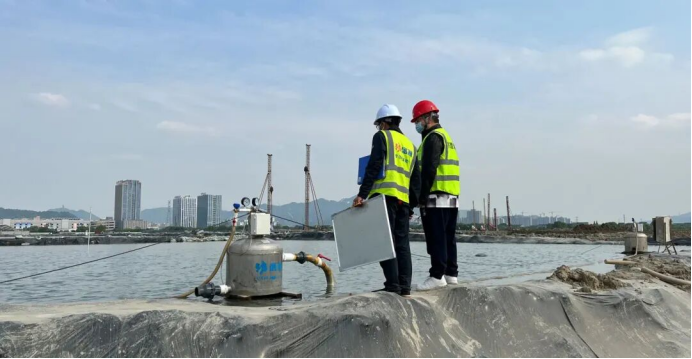
Monitoring Methods
- Settlement plates (settlement monitoring)
- Piezometers (pore water pressure)
- CPT/SPT tests (strength verification)
Shengzhou’s philosophy: “Monitoring is secondary design.”
Only through testing and observation can the effectiveness of ground improvement be truly verified.
V. Typical Application Scenarios
- Ports & Storage Yards – PVD + vacuum or surcharge preloading for heavy container loads.
- Cross-Sea Bridges – Artificial islands reinforced by PVD + vacuum and cement mixing piles, cutting 30% of costs.
- Metro Excavations – Deep mixing + high-pressure grouting forming impermeable barriers (permeability ≤ 10⁻⁷ cm/s).
- Urban Redevelopment – Low-vibration CFG piles and grouting to protect surrounding buildings.
VI. Risks and Limitations
- Environmental constraints: vibration, noise, water pollution.
- Technical limitations: depth and soil-type restrictions.
- Human factors: equipment and operator expertise critical.
- Non-replaceability: deep piles still required for extreme conditions.
VII. Future Development Trends
- Intelligent Monitoring – IoT and real-time visualization of soil behavior.
- Green Materials – Use of lightweight recycled fillers and eco-friendly binders.
- Hybrid Techniques – Combining dynamic compaction with stone columns or vacuum + drainage for optimal performance.
VIII. Shengzhou’s Practice and Advantages
- 20+ years of experience, 300+ completed projects
- 46 patents covering vacuum preloading, dynamic compaction, and anti-clogging drainage systems
- International references: HZMB, Changi Airport, Formosa Steel (Vietnam)
- One-stop service: Investigation → Design → Construction → Monitoring
Philosophy: “A Century of Stability, Built Once to Last Forever.”
Conclusion
Ground Improvement is more than a technical procedure — it’s the cornerstone of structural safety and economic efficiency. From ports to metros, from reclamation to redevelopment, it underpins nearly every major foundation project.
As smart technologies and green construction evolve, GI will become more precise, efficient, and sustainable. Shengzhou looks forward to partnering with more organizations to build solid foundations — ensuring that every great structure stands the test of time.
 English (South Africa)
  English (United States)
  Vietnamese
  Malay
Malay  French
  Spanish
  Indonesian
  Russian
  Arabic
  Thai
Thai  Panjabi
  Portuguese
  Afrikaans
  Amharic