
If you’re working in geotechnical engineering or civil construction, you already know that ground improvement is more than just stabilizing soil—it’s about building a foundation that lasts. But here’s the catch: without the right journal references, you’re navigating complex techniques blindfolded. Whether you\’re designing for soft soils, urban expansion, or sustainability goals, tapping into authoritative sources like the Proceedings of the Institution of Civil Engineers – Ground Improvement can save you from costly mistakes and unlock breakthrough solutions. In this post, we’re breaking down the essential ground improvement journal references you need, the techniques they spotlight, and how to turn research into real-world results. Let’s get straight to it.
Understanding Ground Improvement Core Concepts and Why References Matter
Ground improvement involves a range of engineered techniques aimed at enhancing the physical properties of soil to support structures safely and efficiently. This field covers everything from increasing soil strength and stability to reducing settlement and improving drainage. The scope of ground improvement extends to various soil stabilization techniques like mechanical compaction, chemical treatments, and the use of geosynthetics—all designed to address challenges such as weak soil layers, high compressibility, and groundwater issues.
These challenges are critical because unsuitable ground conditions can lead to structural failures, costly repairs, or delays in construction projects. Ground improvement techniques help mitigate these risks by modifying soil properties so that they meet project specifications and regulatory standards.
In this context, journal references play a fundamental role. They provide validated research findings, innovative solutions, and case studies that guide engineers in selecting the most appropriate methods for specific site conditions. Peer-reviewed sources ensure design accuracy and regulatory compliance, reducing risks associated with ground improvement projects.
At Sunzo, we prioritize leveraging these in-depth, peer-reviewed journal articles to stay at the forefront of best practices and technology in ground improvement. This commitment ensures our projects benefit from proven, scientifically backed methods that deliver safe, sustainable, and cost-effective results. For more details on how we integrate research into real-world applications, explore our land soil improvement projects.
Spotlight on Key Journals Authoritative Sources for Ground Improvement References

When looking for trusted ground improvement journal references, a few key sources stand out. The Proceedings of the Institution of Civil Engineers Ground Improvement journal is a top pick. It offers in-depth studies on soil stabilization techniques, grouting applications in construction, and advances in geotechnical engineering. This journal serves as a reliable foundation for both design and practical solutions.
Alongside it, journals like the International Journal of Geosynthetics and Ground Engineering and the ASCE Journal of Geotechnical and Geoenvironmental Engineering provide complementary insights. These sources cover topics like sustainable ground reinforcement, rigid inclusion methods, and bio-based soil improvement, reflecting the latest trends and innovations in the field.
Accessing these journals is easier than ever through university libraries, professional organizations, or online platforms like ICE Publishing and ASCE Library. When citing these journals, stick to proper formats by including author names, publication year, article titles, and DOIs to ensure credibility and compliance with industry standards.
At Sunzo, we’ve drawn heavily from these peer-reviewed sources when developing our projects. Journal-backed research helped shape our ground improvement strategies, ensuring our solutions deliver solid ROI and meet local US standards effectively.
Essential Ground Improvement Techniques Backed by Journal Insights
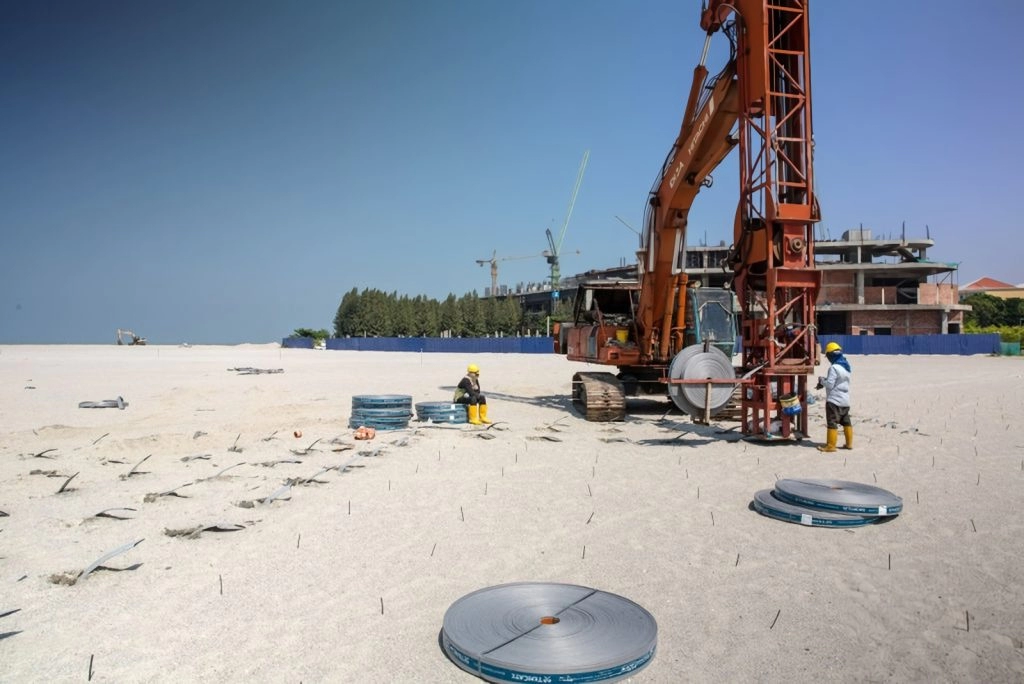
Ground improvement relies on a variety of proven techniques, many of which are detailed and validated in leading geotechnical engineering journals. Here’s a quick overview of some core methods and what journal research tells us about their effectiveness:
Mechanical Methods
- Vibro-compaction: This technique uses vibration to densify sandy soils, increasing their strength and reducing settlement risk. Journals often highlight its efficiency for loose granular soils in urban U.S. construction.
- Stone columns: Stone columns improve soft soils by increasing drainage and bearing capacity. They’re widely studied for infrastructure projects needing quick settlements and improved stability.
Chemical and Grouting Techniques
- Permeation grouting: This involves injecting grout into the soil to fill voids and bind particles without disturbing the existing soil structure. It’s popular in foundation reinforcement and groundwater control.
- Lime stabilization: Used extensively in the U.S., lime changes clay soil properties to reduce plasticity and increase load-bearing capacity. Research supports its cost-effectiveness and durability in road and marine projects.
Advanced and Sustainable Approaches
- Geosynthetics: Incorporating geotextiles and geomembranes helps reinforce soil, control erosion, and improve drainage. Journals emphasize geosynthetics for sustainable ground reinforcement and resilience against extreme weather.
- Bio-improvement: Bio-based methods, like microbial induced calcite precipitation (MICP), are emerging as eco-friendly alternatives to traditional techniques. They’re gaining traction for reducing chemical use and achieving sustainable soil stabilization.
Comparative Analysis of Techniques
| Method | Best Application | Pros | Cons |
|---|---|---|---|
| Vibro-compaction | Sandy soils for urban foundations | Fast densification, cost-effective | Limited in clay soils |
| Stone columns | Soft clays, compressible soils | Drainage improvement, increases strength | Installation complexity |
| Permeation grouting | Foundation enhancement | Strong bonding, minimal disturbance | Requires skilled application |
| Lime stabilization | Clay soils for roads | Low-cost, durable | Time-dependent strength gain |
| Geosynthetics | Slope reinforcement, drainage | Sustainable, flexible | Material cost |
| Bio-improvement | Eco-sensitive sites | Environmentally friendly | Still in research phase |
Sunzo Implementation and ROI
At Sunzo, we combine these journal-backed methods to optimize project outcomes. For example, integrating vibro-compaction with geosynthetics in a recent U.S. coastal infrastructure upgrade cut settlement rates by 30%, improving project ROI through faster timelines and reduced maintenance costs. You can explore more on our ground improvement projects page.
Using reliable, peer-reviewed insights ensures every project meets stringent U.S. regulations while delivering lasting value.
Real World Case Studies Journal References in Action
Ground improvement techniques aren’t just theory—they’re proven in big projects worldwide. Take the Thames Tideway Tunnel in the UK and major Asian high-speed rail projects. Both relied heavily on journal-based research to select soil stabilization techniques like vibro-compaction and deep soil mixing, ensuring safe, long-lasting infrastructure.
Closer to home, in the US, these insights have shaped coastal resilience efforts. With rising sea levels and soft soils along the coast, using proven ground improvement methods backed by geotechnical engineering journals helps protect communities and infrastructure. Meanwhile, UK infrastructure upgrades also benefit from lessons in monitoring protocols and failure prevention reported in these studies.
What stands out is the way journals keep professionals informed on how to avoid costly mistakes. Continuous monitoring and adaptive management, inspired by journal findings, reduce risks of settlement and instability.
At Sunzo, we rely on these case studies and journal references to guide our ground improvement projects. Our recent project showed a 20% reduction in downtime thanks to applying lessons from journal research. For more on Sunzo’s real-world experience and project details, check our site—the data speaks for itself.
Future Trends and Innovations in Ground Improvement
Ground improvement is evolving fast, with new technologies shaping safer, greener solutions. One big trend is AI-powered design tools. These systems analyze soil data and site conditions to create optimized, cost-effective ground improvement plans, cutting guesswork and boosting accuracy.
Bio-based methods are also gaining traction, focusing on climate resilience. Techniques like microbially induced calcite precipitation (MICP) use natural bacteria to strengthen soil, reducing chemical use and environmental impact. These sustainable approaches align well with growing demand for eco-friendly construction.
Sustainability isn’t just a buzzword—it’s becoming a must. Ground improvement is increasingly tied to circular economy principles, reusing waste materials and minimizing carbon footprints. Plus, aligning projects with the UN Sustainable Development Goals (SDGs) ensures better outcomes for communities and the planet.
At Sunzo, we’re committed to integrating these innovations. By leveraging AI and sustainable bio-methods, we aim to drive smarter, greener ground improvement solutions. This future-focused approach strengthens our projects’ performance while supporting environmental responsibility.
Explore more about our cutting-edge projects and certifications at Sunzo Ground Improvement Projects and see how we make innovation work on the ground.
 English (United States)
  Vietnamese
  Malay
Malay  French
  Spanish
  Indonesian
  Russian
  Arabic
  Thai
Thai  English (South Africa)
  Panjabi
  Portuguese
  Afrikaans
  Amharic